
Monday, 10 May 2010


Sunday, 9 May 2010
World Builder
World Builder from BranitVFX on Vimeo.
A lovely vision of the future and a spellbinding movie that took a day to shoot and two years in post-production. By Bruce Branit of Kansas.
Saturday, 8 May 2010
Plots

Illustration by Slug Signorino
I could find plenty of discussion about this, but no consensus on the actual number. The main problem seems to be the definition of how detailed you get with the definition of the story plot.
However, Cecil Adams in The Straight Dope plot article explains it nicely and I do like his final words:
"My point is, never mind the 36, 20, 7, or whatever basic plots--take out sex, violence, and death and you lose 90 percent of literature right there."
But this is all just a preamble to this great little piece of writing I found.
Click on it to read it more easily.

Thursday, 6 May 2010
How to Paint a Still Life. Part 1. Drawing.
Here is a part of that still life I set up. This is what I will develop into a painting.
My brief is to build up the layers with a succession of thin glazes, in the manner of the Dutch masters, so the work has harmony and depth.
I will choose the 'earth' colours for my pallette so as to emulate the dullish, even, characteristic tones of the classical still life.
First I do a series of drawings to familiarise myself with my subject. Deciding to leave out the grapes, in order to make the composition more tidy, I do:
1. blind drawings, only looking at the subject and not the paper. These look funny when they are finished but they are excellent for making me really see what I have in front of me. Blind drawings hone my 'artist's eye'.
2. contour, or outline drawings, so I see the big shapes.
3. negative shape drawing. This is the space between and around objects. These shapes should be interesting and relatively balanced. This is an important part of the composition.
4. Tonal drawings, that help me to focus upon the lightest lights, and the darkest darks.
 5. Choosing a light colour wash that will enrich my final work, I paint over my canvas. This is called a tonal ground. The colour chosen is based on experience and has the effect of setting an atmosphere. Cool colours mute and warm colours tend to make the painting look more lively. I have chosen the warm raw sienna.
6. Using one of my line drawings, or 'cartoons', I transfer it to my canvas. I use a square grid to enlarge it accurately. So that my line drawing is able to be consulted later, I overlay it with a grid that I ruled up with felt-pen on a piece of acetate. A heated piece of laminating film is ideal for this. I just use a pencil at this point.
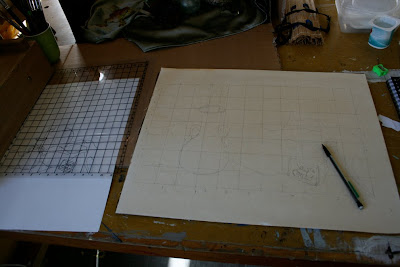 7. Using a thin long soft watercolour brush, I go over the outline again. I use thinned raw umber. When completely dry I rub out the pencil grid.
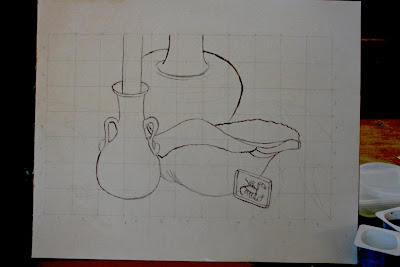 8. Consulting my tonal drawings and the subject in front of me, and using a thinned wash of burnt sienna, raw umber and prussian blue mixed, I block in the darks. I don't worry too much that this layer doesn't look very even. It will be built up in successive layers and the patchy look will disappear.

 7. Using a thin long soft watercolour brush, I go over the outline again. I use thinned raw umber. When completely dry I rub out the pencil grid.
 8. Consulting my tonal drawings and the subject in front of me, and using a thinned wash of burnt sienna, raw umber and prussian blue mixed, I block in the darks. I don't worry too much that this layer doesn't look very even. It will be built up in successive layers and the patchy look will disappear.

Next: Part 2.
Sunset over the boiler-room
 This was the view from my car in the car-park yesterday as I was loading up to go home. The nights are drawing in and it's quite nippy some mornings. Time to clear out the ash from last year and hope there's no nest up in the chimney.
Monday, 3 May 2010
Rainbow over the Kaimais

 I was driving over the Kaimai Range on Saturday, and the patches of autumn sunshine and patches of light rain made just the right conditions for this rainbow. There's something so alluring about rainbows, isn't there? I found a safe spot and pulled over to snap these images. But I noticed the colours looked brighter through the polarised windscreen of the car, than through the open window. I'll have to look up why that would have been.
But I can't let this opportunity go by without directing you to this clip about rainbows that I have previously posted.
Saturday, 1 May 2010

Subscribe to:
Posts (Atom)